


Techniques for Emotional Regulation: A Guide to Build Resilience
Techniques for Emotional Regulation

The human of today is experiencing a transformation and uncertainty on both Individual and organizational level due to the:
- Technological advancements
- Economic volatility
- Social change
- Global challenges
The industries are reshaping faster than past with advanced digital approaches including:
- Artificial intelligence
- Automation,
- Digital innovation
On other side the geopolitical tensions, climate concerns, and shifting workforce expectations are further adding the complexity.
The demand of such evolving environment is to be more agile, clear, and resilient than ever to cope with the such dynamic and complexed environment.
Individuals must learn to navigate immediate pressures such as:
- Meeting deadlines
- Adapting to new tools
- Managing stress
This all requires continuous learning and strategic foresight.
When we focus too much on short-term emotional reactions, it easily disrupt our:
- decisions
- Relationships
- Performance
When we focus too much on suppressing emotions, we risk:
- Losing authenticity
- Compromising our emotional well-being
The challenge we face in such situation is not to choose one option over to the other. It is about a balance by acknowledging both emotions and while guiding them in ways that sustain:
- Health
- Productivity
- Meaningful progress
This balance lies at the core of emotional regulation.
Far from being a “soft skill,” it is increasingly recognized as a strategic capability. A power skill that enables to[SS1] remain effective in the midst of disruption.
According to the research in psychology and neuroscience, those who regulate emotions, they experience well the:
- Higher resilience
- Reduced burnout
- Stronger relationships
- Better decision-making
This blog provides a comprehensive guide to emotional regulation techniques:
- What they are?
- Why they matter?
- Frameworks that explain them
- Practical tools can be applied in both professional and personal life.
Understanding Emotional Regulation (ER)
It is the ability to monitor, evaluate, and adjust emotional responses. Effective supportive skill in alignment of long-term goals and values.
Rather than suppression to ignore feelings, ER is about channeling emotions effectively.
It means asking, how can I:
- Prevent frustration from judgment?
- Maintain clarity and composure in overwhelmed stress?
- Harness the emotions like empathy, optimism, or curiosity to enhance performance?
In professional contexts, unregulated emotions often:
- Manifest as reactive decisions
- Strained team dynamics
In personal contexts, they can:
- Fracture relationships
- Heighten anxiety
- Weaken resilience
Regulation bridges the gap between reaction and response.
Role of Emotional Regulation in Leaders, Professionals, and Individuals life

For Leaders and Executives
Emotions set the tone for organizational culture.
Leaders who regulate emotions are capable to:
- Make clear decisions under pressure
- Inspire stability and trust across teams
For Entrepreneurs
Emotional volatility can mean the difference between:
- Seizing opportunities
- Sabotaging negotiations
In long-term growth, the regulation builds the required:
- Patience
- Clarity
For Individuals
On a personal level, emotional regulation is the foundation of:
- Mental health
- Empathy
- Balanced relationships
It transforms stress into strength.
Statistic: Studies show leaders with strong emotional regulation skills:
- Improve team performance by up to 23% .
- Reduce workplace stress by 30%.
The Science and Frameworks Behind Emotional Regulation
Better understanding of following models can help regulate emotions.
- Gross’s Process Model of Emotional Regulation
Psychologist James Gross proposed one of the most influential models. It, identifies five stages of regulation:
- Situation Selection
Choosing to enter—or avoid—certain situations that influence emotions.
- Situation Modification
Adjusting aspects of an environment to reduce stress.
- Attentional Deployment
Directing focus away from emotional triggers.
- Cognitive Change (Reappraisal)
Reframing how we interpret events.
- Response Modulation
Managing outward expression and physiological responses.
This model shows that regulation is not a single act but a process. It offers multiple points of intervention.
- The SPDG Framework (Synergy, Performance, Differentiation, Growth)
Originally developed for business strategy, this framework also applies to emotional intelligence:
- Synergy
Align emotions with core values and vision.
- Performance
Use targeted techniques (like breathing or mindfulness) to enhance outcomes.
- Differentiation
Develop resilience as a competitive edge.
- Growth
Scale emotional skills over time, turning them into long-term strengths.
8 Powerful Emotional Regulation Techniques
| Technique | Description / Example | Key Benefit |
| 1. Cognitive Reappraisal (Reframing) | Shift how you interpret situations. Example Instead of saying; “I failed this project,” Reframe it as; “I gained insights that will guide my next success.” | Reduces stress Broaden perspective |
| 2. Breathing & Relaxation Exercises | Use calming techniques to lower cortisol and reset the nervous system. Box breathing (inhale 4, hold 4, exhale 4, hold 4) | Creates immediate calm during crises or high-pressure meetings. |
| 3. Mindfulness Practices | Stay present and aware to avoid overthinking past mistakes or future anxieties. Example Begin meetings with one minute of mindful silence. | Improves: * Focus * Creativity * Emotional balance |
| 4. Journaling & Expressive Writing | Translate emotions into words to: * Clarify thoughts * Release mental tension. | Enhances: self-awareness Emotional clarity |
| 5. Physical Exercise | Engage in regular movement or exercise to: * Reduce stress hormones * Increase mood-boosting endorphins | Builds both mental and physical resilience. |
| 6. Positive Self-Talk | Replace negative inner dialogue; “I can’t handle this” with empowering affirmations; “I’ve overcome challenges before; I can do it again” | * Strengthens confidence * Reduces anxiety |
| 7. Problem-Solving Orientation | Go beyond managing emotions Focus on identifying and addressing the root causes of stress or frustration. | Develops sustainable, long-term resilience. |
| 8. Social Support | Share emotions with trusted peers, mentors, or loved ones to: Gain perspective Emotional relief | Prevents isolation Fosters connection. |
Case Studies: Emotional Regulation in Action
- Satya Nadella at Microsoft
Nadella by emphasizing empathy and emotional intelligence reshaped Microsoft’s culture. It is improving innovation and collaboration.
- Healthcare Leaders During COVID-19
Hospitals led by emotionally intelligent leaders reported despite overwhelming pressure:- higher staff morale
- Lower turnover
- Elite Athletes
Champions like Novak Djokovic use mindfulness and breathing techniques. Enabling them in maintaining composure under intense match conditions.
These cases highlight that emotional regulation is not theoretical. It directly influences outcomes across domains.
Data Insights: The Measurable Impact of Emotional Regulation
Bar chart here for visualization: Stress Reduction | Decision-Making | Relationships)
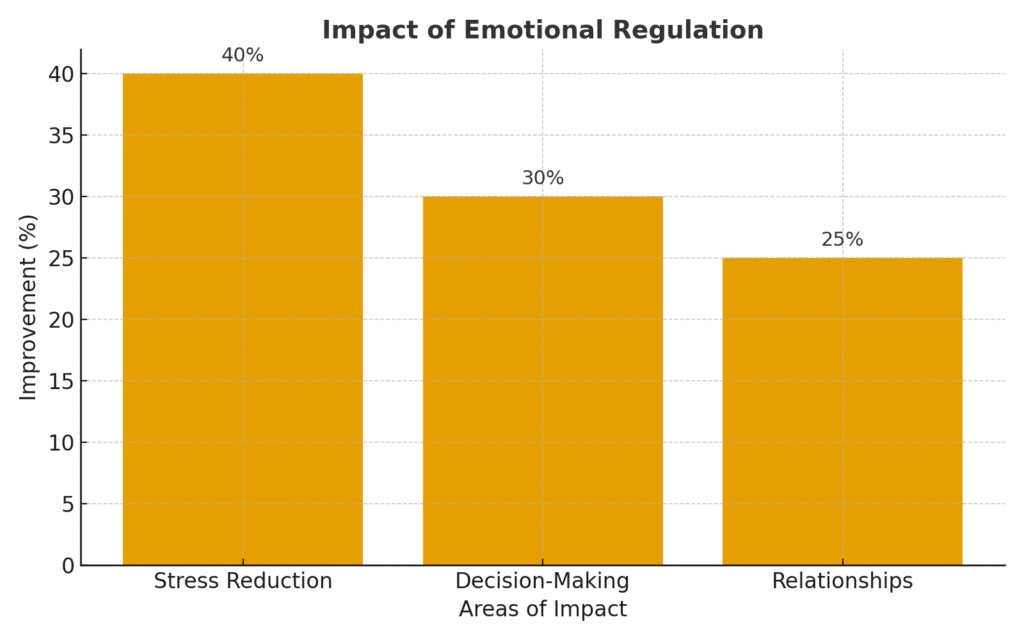
Research consistently links regulation with tangible outcomes:
- 40% reduction in stress.
- 30% improvement in quality decision-making.
- 25% stronger interpersonal relationships
Practical Framework: Daily Integration of Emotional Regulation
The more consistently we practice, the emotional regulation becomes stronger.
Practical framework
| Aspect | Description | Purpose / Benefit | Practical Example or Tip |
| Morning Routine | Begin the day with 5 minutes of mindfulness Breathing exercises | Cultivates calmness Focus before the day’s pressures begin | * Try simple deep breathing: inhale for 4 seconds * Hold for 4 * Exhale for 4 * Focus on presence, not perfection. |
| Workday Integration | Apply the “90-second rule” pause before reacting to stress or emotion. | Creates a mental buffer Reducing emotional overreactions | When frustrated: take 90 seconds to breathe, reflect, and then respond calmly. |
| Evening Practice | Engage in journaling Reframe the day’s challenges | Encourages: * Reflection * Emotional release * Shift from negative to constructive thinking | Write 3 sentences each night: * One challenge * One insight * One gratitude |
| Weekly Reflection | * Review emotional experiences * Evaluate which regulation techniques worked best. | Promotes: * Self-awareness * Continuous improvement * Emotional intelligence | Ask yourself: * “What triggered me this week?” * “Which responses made me feel proud or peaceful?” |
| Long-Term Impact | Consistent practice of ERT: * Builds resilient mindset * Capability to handle uncertainty, change and challenges | Transforms emotional regulation into a stable personal strength Supports performance, relationships, and well-being. | Use reminders to sustain practice Remember consistency matters more than intensity |
FAQs on Techniques for Emotional Regulation
Q1: What is the most effective Emotional Regulation Technique (ERT)?
The research shows that the following are strongest and effective ERT:
- Cognitive reappraisal
- Mindfulness consistently
Q2: Can ERT be taught?
Yes.
Leadership programs, therapy, and coaching routinely include ERT.
Q3: Is it only for professionals?
No. It benefit equally all individuals of different backgrounds.
Q4: How long does it take to learn?
It is an ongoing effort. With consistent practice, individuals experience within short time the noticeable improvements.
Techniques for Emotional Regulation: Conclusion

In the time when uncertainty is the only certainty, emotional regulation stands out as a core determinant of:
- Resilience,
- Leadership
- Sustainable growth
It is not merely about controlling emotions but about aligning them with purpose. Enabling:
- Leaders to inspire
- Professionals to perform
- Individuals to thrive
👉 Call to Action: Start small, no matter, but initiate.
- Choose one technique
- Be mindful and journaling, or reappraisal
- Integrate it into your routine
Read Alos: Structured Framework for Your Business Growth
Resilience Meaning: How It Drives Success in Business and Personal Growth
