


SPDG – Strategic Partnerships Drive Growth Model
In today’s competitive marketplace, growth is no longer about internal resources only. The successful companies harness the Strategic Partnerships Drive Growth (SPDG). It does not matter either these companies are in the phase of emerging startups or have been global enterprises.
SPDG is not a trend. It has evolved into a CEO’s framework for the future. It redefines how businesses innovate, scale, and compete. It Serves as catalysts that combine execution with innovation.
Strategic partnership helping organizations to deliver reliable results today while building the capabilities for tomorrow. The SPDG model provides a future-ready approach to entrepreneur and executive. Enables them in achieving sustainable growth.
Understanding Strategic Partnerships Drive Growth (SPDG)

SPDG is a structured growth framework which is built on 4 pillars:
- Synergy
- Performance
- Differentiation
- Growth Scalability
Unlike conventional alliances, it emphasizes on long-term value creation, addition and adaptability. Helping leaders vision beyond transactional partnerships and create ecosystems of innovation and resilience.
Importance and Scope of Strategic Partnerships
Importance
As we understand that companies can no longer rely solely on internal capabilities, especially in an era which is defined by the disruption. Strategic partnerships boost/create:
- New markets
- Shared expertise
- Technological advancement
- Scaling opportunities
According to a PwC survey;
“75% of CEOs believe that strategic partnerships are critical for innovation and long-term competitiveness. “
The SPDG model ensures these partnerships are not opportunistic but transformative, driving both:
- Immediate value
- Sustainable growth
Scope of SPDG
The SPDG framework is not a tactic but it is a strategic management model. It integrates partnerships into the core of an organization.
Its scope extends across multiple dimensions such as:
- Business Growth & Market Expansion
- Innovation & Technology Advancement
- Operational Efficiency & Resource Optimization
- Financial Resilience & Risk Sharing
- Talent & Knowledge Sharing
- Brand Value & Customer Experience
- Societal & Sustainability Impact
The Future of Business: Trends, Technology, and Growth Strategies
The SPDG Framework

The SPDG framework is structured around four pillars that guide leaders in building impactful partnerships.
| Pillar | Description |
|---|---|
| Synergy | To create combined value greater than the sum of parts align: * Resources * Expertise * Vision Example: Microsoft and OpenAI combining cloud infrastructure with cutting-edge AI research. |
| Performance | Ensure partnerships deliver measurable business outcomes by establishing: * KPIs * Joint accountability * Shared performance dashboards |
| Differentiation | Leverage unique strengths of each partner to create competitive advantage. Example: Apple’s collaborations with Nike; shows unique combination of lifestyle and the technology. |
| Growth Scalability | Design partnerships with scalability in mind, able to expand across: * Geographies * Markets * Industries Example: Starbucks’ global bottling partnership with Pepsi exemplifies this. |
Balancing Execution and Innovation
A key feature of SPDG is its ability to balance two forces:
- Disciplined execution
- Continuous innovation
Execution ensures reliable delivery of today’s objectives. Innovation prepares organizations for future disruptions.
Companies like Nokia demonstrate the risks of execution without innovation. While others that chase trends without execution fall into chaos.
SPDG creates structured balance, enabling stability with reinvention.
Use Cases & Examples of SPDG
- Technology Sector
Microsoft’s strategic partnership with OpenAI enabled both firms to combine cloud infrastructure with AI innovation.
Accelerating progress for both.
- Retail & Logistics
Walmart’s alliances with logistics partners have scaled same-day delivery.
Making operations both efficient and customer-centric.
- Healthcare
- Mayo Clinic’s collaborations with digital health startups.
Illustrating execution in patient care with enhanced by innovative technology.
These examples show, SPDG is not industry-specific but adaptable across contexts.
Risks & Challenges in Strategic Partnerships
While partnerships can drive growth, they also bring risks such as:
- Misaligned goals
- Cultural mismatches
- Over-dependence on partners
The SPDG model mitigates these by emphasizing on:
- Structured alignment
- Shared metrics
- Scalability
Leaders must conduct thorough due diligence. Also, they should establish clear governance structures to ensure resilience.
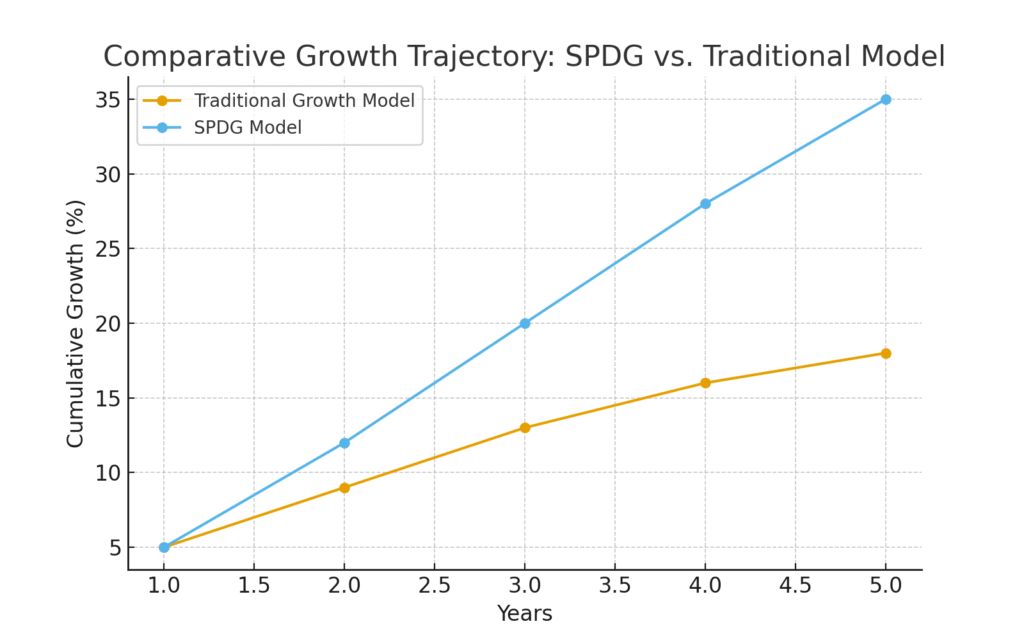
Evidence that SPDG Outperforms Traditional Models
Research indicates that companies leveraging structured partnerships grow 30% faster than those relying only on organic growth.
A study by Deloitte showed that ecosystems-based businesses outperform peers in profitability by up to 12%.
Below is a conceptual representation of how SPDG companies outperform traditional peers.
Leadership Takeaways for CEOs and Entrepreneurs

1️⃣ SPDG as a Leadership Compass
The Strategic Partnerships Drive Growth model is a leadership compass.
For CEOs and entrepreneurs, it offers a way to navigate the challenges that occurs between:
- Operational execution
- Continuous innovation
2️⃣ Align Execution with Innovation
The SPDG model encourages leaders to balance both:
- Execution
- Innovation
Enabling them to build reliable operations, satisfy stakeholders and ensures organization constant competitiveness.
3️⃣ Prioritize High-Value Partnerships
It is a fact that every partnership cannot drive growth. Leaders have to prioritize those that create dual value:
- Delivering immediate returns
- Opening pathways for future opportunities.
SPDG emphasizes selecting partners who:
- Complement core strengths
- Expand market reach
- Unlock new capabilities
4️⃣ Build Trust with Transparency
Strong partnerships thrive on trust through transparency.
SPDG ensures that all parties remain aligned and accountable by embedding:
- Shared KPIs
- Joint accountability mechanisms
- Performance dashboards
This openness:
- Reduces friction
- Strengthens relationships
- Accelerates results.
5️⃣ Scale with Adaptability
Markets evolve rapidly. Leaders who succeed with SPDG treat partnerships as active systems which is:
- Scalable
- Flexible
- Responsive to change
Even in disruptive environments, CEOs and entrepreneurs can ensure partnerships remain relevant and growth-focused by continuously:
- Monitoring performance
- Adjusting terms,
FAQs about SPDG
How it differ from traditional partnerships?
SPDG emphasizes scalability, innovation, and long-term resilience beyond transactional collaboration.
Can small businesses apply Strategic Partnership Growth model?
Yes, startups and SMEs can leverage SPDG by forming alliances that share resources and co-create value.
What industries benefit most from this growth framework?
Technology, healthcare, retail, and finance benefit significantly, but any industry facing disruption can adopt it.
What risks are involved in SPDG?
Risks include:
- Misalignment
- Over-dependence
- Execution failures, mitigated through structured governance.
How it prepares companies for the future?
By balancing execution with innovation, it ensures organizations remain relevant in dynamic environments.
Conclusion and CTA
The evidence is clear that rather than solo efforts;
Growth in the modern economy is increasingly shaped by strategic partnerships.
The SPDG framework outline to synergy, performance, differentiation, and growth scalability. For leaders who want to balance stability with reinvention, it offers a highly workable roadmap
SPDG is not just about collaboration. It builds a resilient ecosystem where every alliance multiplies long-term value.
Those who are able to align execution with innovation they stay relevant. Also, they raise the dimensions for the future of business.
👉 Now is the time to embed SPDG into your growth strategy because partnerships don’t just support growth, they drive it. Share your comment in box below.